
San Francisco to Tokyo: How to Actually Communicate With Your Japan Team Without Losing Sleep
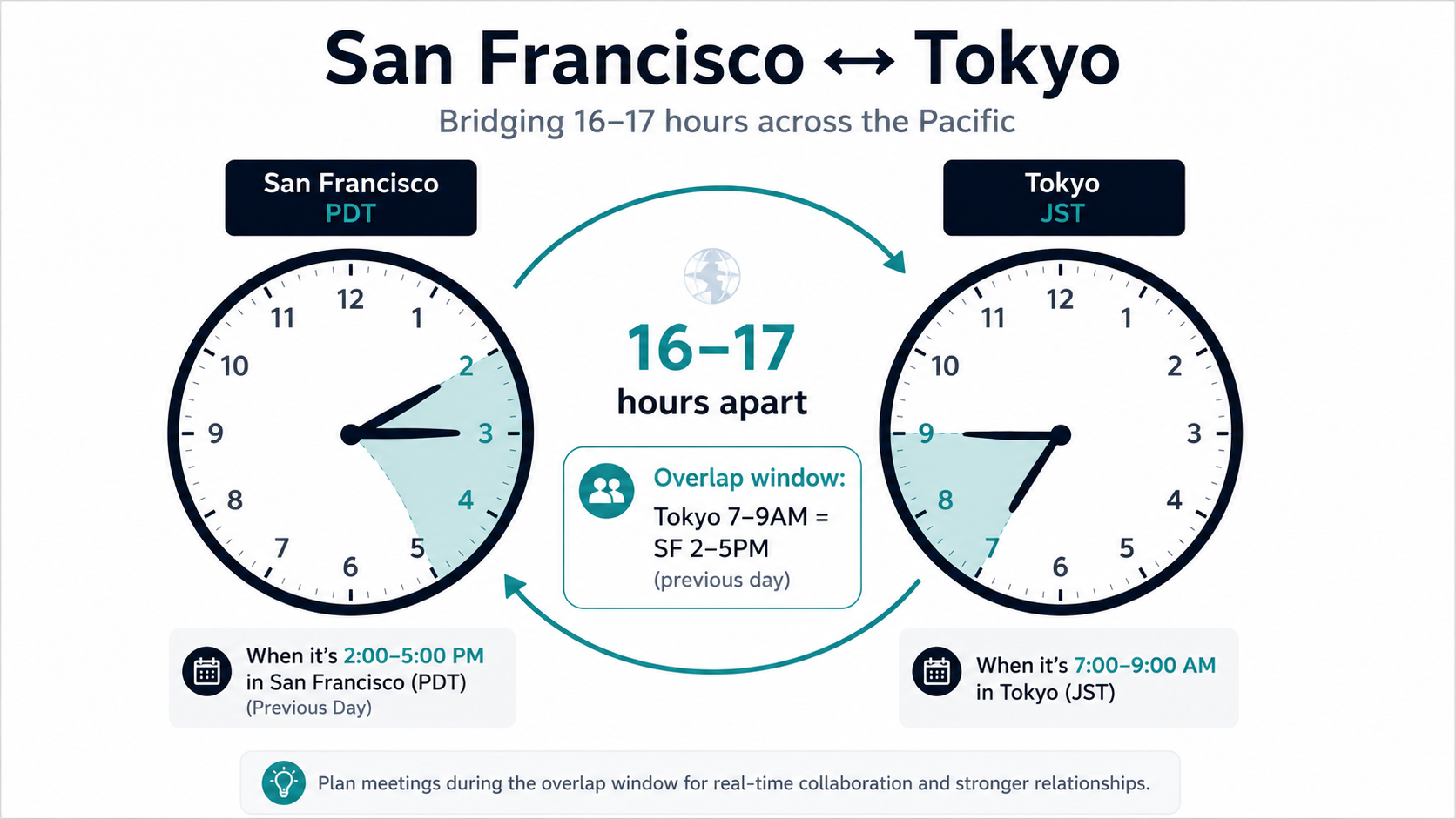
If you're a founder or exec in the Bay Area trying to set up a company in Japan, there's a problem nobody puts in the pitch deck: the two cities are on almost exactly opposite clocks. Tokyo is 16 hours ahead of Pacific Standard Time (17 hours ahead of Pacific Daylight Time during US daylight saving). There is no clean midday overlap. If you try to "just hop on a call," someone is waking up at 4am.
This isn't a minor logistics annoyance. For overseas founders going through incorporation, the Business Manager visa, bank account setup, and early hiring, timezone friction is one of the quiet reasons Japan launches slip from "6 months" to "10 months." Every round-trip email — a bank asking for one more document, an immigration lawyer needing a clarification, a landlord wanting a signature — costs a full calendar day if it has to wait for the other side to wake up.
This post walks through the actual math, the one overlap window that works, and how we handle it for founders we work with.
The real math: what "16 hours ahead" means for your calendar
Tokyo runs on Japan Standard Time (JST), which is UTC+9 year-round — Japan doesn't observe daylight saving. San Francisco runs on Pacific Time, which is UTC-8 in winter (PST) and UTC-7 in summer (PDT).
That gives you:
- Winter (PST): Tokyo is 17 hours ahead of San Francisco
- Summer (PDT): Tokyo is 16 hours ahead of San Francisco
Because the gap is close to a full 24 hours, it's easiest to think of it as "almost a full day apart, but not quite" — which actually creates one small, useful sliver of overlap rather than zero.
Here's the conversion table worth bookmarking:
| Tokyo time (JST) | San Francisco time (PDT, summer) | San Francisco time (PST, winter) |
|---|---|---|
| 7:00 AM | 3:00 PM (previous day) | 2:00 PM (previous day) |
| 8:00 AM | 4:00 PM (previous day) | 3:00 PM (previous day) |
| 9:00 AM | 5:00 PM (previous day) | 4:00 PM (previous day) |
| 10:00 AM | 6:00 PM (previous day) | 5:00 PM (previous day) |
| 9:00 PM | 5:00 AM (same day) | 4:00 AM (same day) |
| 12:00 AM (midnight) | 8:00 AM (same day) | 7:00 AM (same day) |
Notice what this actually means: Tokyo's morning is San Francisco's previous afternoon. If your Japan-side contact is at their desk at 7–10AM Tokyo time, you can reach them at 2–6PM the day before, San Francisco time — right in the middle of a normal SF workday.
That's the window. Everything else on the clock is either the middle of the night for one side or the other.
Why "just schedule a call" doesn't actually solve this
A lot of founders' first instinct is to treat this like any other remote-team timezone gap — "we'll just find a slot, someone stays up late once a week." That works for a weekly sync. It does not work for the density of communication a Japan launch actually requires.
Incorporation, the Business Manager visa application, bank account opening, and early hiring all involve short, urgent, document-driven exchanges — not long strategic calls. A bank compliance officer flags a missing seal. Immigration wants one clarifying line about your business plan. A shihoshoshi needs a signature before a filing deadline. These aren't things you schedule a Zoom for; they're things that need a same-day answer, in Japanese, from someone who's actually awake and at a desk in Tokyo when the question comes in.
If every one of those exchanges has to wait for a scheduled call, or for someone in SF to notice a message at 11PM, your timeline stretches — not because anything is legally or bureaucratically hard, but because of pure calendar drag.
A short story: what this actually looks like in practice
One founder we worked with — a SaaS company relocating from the Bay Area — described it well: He handled the hard parts with a Smart PM managing it from Tokyo, the office address was secured and the company was already incorporated by the time he landed. That meant the bank application could go in during his first week on the ground — and the corporate account cleared a few weeks later, in time to run his first payroll the following month. The difference wasn't magic; it was having someone on the Japan side push each step forward during Tokyo business hours instead of him trying to bridge 17 hours solo.
That's the actual value of having a dedicated point of contact on the Japan side: not that they magically make the timezone gap disappear, but that they absorb it. They're awake and working while you're asleep, they push things forward on your behalf during Tokyo business hours, and they hand you a clean summary when you wake up — instead of you waking up to five disconnected emails from five different Japanese specialists, none of whom write in English.
How we handle it for founders working with a Smart PM
This is exactly the problem the Smart PM role at Smart Contents is built around. A few concrete details on how it works day-to-day:
Morning Tokyo hours are treated as the primary overlap window. Your Smart PM is at their desk from early morning Tokyo time specifically because that's when it lines up with your previous afternoon in San Francisco — so a message you send at 3PM Pacific gets picked up first thing the next Tokyo morning, not 12 hours later.
Late-Tokyo-night calls are available when something is genuinely time-sensitive. If there's a real deadline — a bank appointment window, a visa filing cutoff — your Smart PM can take a call as late as 1AM Tokyo time, which lands around 8–9AM Pacific. We won't pretend that's a comfortable standing meeting slot for us, but it exists for the moments that can't wait for the next overlap window.
Communication happens on whatever channel you actually check. Not everyone lives in their email inbox, and a bilingual PM shouldn't force you onto one. Depending on what you prefer, your Smart PM can reach you by:
- Email — for anything formal, or that needs a paper trail (contracts, visa document requests, bank correspondence)
- WhatsApp — the default for most overseas founders and HQ teams, since it's already what your team uses for quick back-and-forth
- LINE — Japan's dominant messaging app; useful once your PM is also coordinating with Japan-side hires, landlords, or local vendors who live on LINE
- Instagram DM — for founders who genuinely just prefer keeping business chat inside a platform they already have open all day
The point isn't the specific app — it's that the burden of bridging 16 hours sits with your PM, not with you having to guess which of five inboxes to check at 6AM.
Monthly English reporting removes the need for real-time syncs entirely for most updates. Not everything needs a live conversation. Status updates, visa progress, and financial reporting arrive as a structured English report on a set cadence, so your board or HQ isn't dependent on catching someone awake to get an update.
Practical tips if you're doing this without a dedicated PM
If you're earlier-stage and coordinating this yourself for now, a few things that meaningfully reduce the pain:
- Batch your questions. Instead of sending one email per question as it occurs to you, hold them and send a single list once a day, timed to land at the start of Tokyo's morning (i.e., sent from SF in the afternoon the day before).
- Default to async, not calls. Voice memos or detailed written messages travel across a 16-hour gap far better than "let's hop on a call" — which usually just adds a full day of back-and-forth to schedule.
- Ask every Japan-side contact for their actual working hours, not just "Japan business hours" — gyoseishoshi, banks, and landlords all keep slightly different windows, and knowing the real one prevents you from waiting a full extra day unnecessarily.
- Put critical deadlines on both calendars in both timezones. A visa filing deadline that's "Friday" in Tokyo is already Thursday afternoon in San Francisco — a mismatch that causes real, avoidable delays if it's only tracked in one timezone.
The bottom line
There's no way to make San Francisco and Tokyo share a comfortable overlap — the geography doesn't allow it. But there is one real window (Tokyo's early morning / SF's previous afternoon), and the founders who move fastest through incorporation, visa, and banking are the ones who structure their communication around that window instead of fighting the clock in real time.
If you're planning a move from the Bay Area — or already mid-launch and feeling the timezone drag — a 45-minute discovery call is a good place to figure out how this would actually work for your specific case, including who on our side would be your point of contact and how we'd structure updates around your working hours.
Book a free 45-minute discovery call →
This article is for general informational purposes. Visa outcomes are subject to Japanese immigration authority review and are not guaranteed.